Chinese Modernization: A New Model for Development
--By Consul-General You Wenze, published on Cape Times, June 26
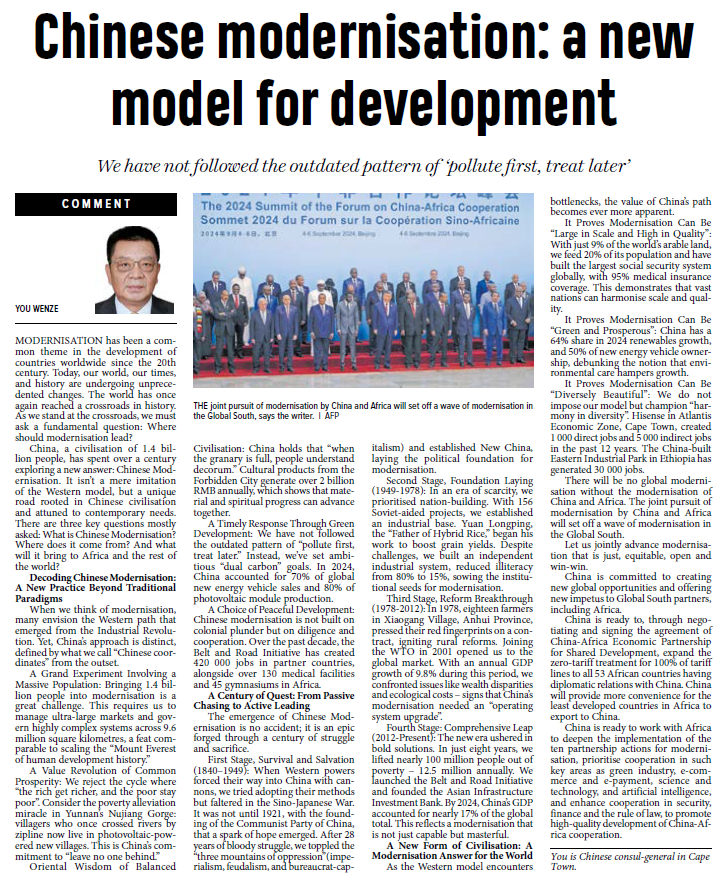
Modernization has been a common theme in the development of all countries in the world since the 20th century. Today, our world, our times, and history are undergoing unprecedented changes. The world has once again reached a crossroads in history. As we stand at the crossroads, we must ask a fundamental question: Where should modernization lead?
China, a civilization of 1.4 billion people, has spent over a century exploring a new answer: Chinese Modernization. It isn’t a mere imitation of the Western model, but a unique road rooted in Chinese civilization and attuned to contemporary needs. There are three key questions mostly asked: What is Chinese Modernization? Where does it come from? And what will it bring to Africa and to the world?
1. Decoding Chinese Modernization: A New Practice Beyond Traditional Paradigms
When we think of modernization, many envision the western path that emerged from the Industrial Revolution. Yet, China’s approach is distinct, defined by what we call "Chinese coordinates" from the outset.
A Grand Experiment Involving a Massive Population: Bringing 1.4 billion people into modernization is a great challenge . This requires us to manage ultra-large markets and govern highly complex systems across 9.6 million square kilometers—a feat comparable to scaling the "Mount Everest of human development history."
A Value Revolution of Common Prosperity: We reject the cycle where "the rich get richer, and the poor stay poor". Consider the poverty alleviation miracle in Yunnan’s Nujiang Gorge: villagers who once crossed rivers by zipline now live in photovoltaic-powered new villages. This is China’s commitment to "leave no one behind."
Oriental Wisdom of Balanced Civilization: China holds that "when the granary is full, people understand decorum." Cultural products from the Forbidden City generate over 2 billion RMB annually, which shows that material and spiritual progress can advance together.
A Timely Response Through Green Development: We have not followed the outdated pattern of "pollute first, treat later." Instead, we’ve set ambitious "dual carbon" goals. In 2024, China accounted for 70% of global new energy vehicle sales and 80% of photovoltaic module production.
A Choice of Peaceful Development: Chinese modernization is not built on colonial plunder but on diligence and cooperation. Over the past decade, the Belt and Road Initiative has created 420,000 jobs in partner countries, alongside over 130 medical facilities and 45 gymnasiums in Africa.
2. A Century of Quest: From Passive Chasing to Active Leading
The emergence of Chinese Modernization is no accident—it is an epic forged through a century of struggle and sacrifice.
First Stage, Survival and Salvation (1840 -1949): When Western powers forced their way into China with cannons, we tried adopting their methods but faltered in the Sino-Japanese War. It was not until 1921, with the founding of the Communist Party of China, that a spark of hope emerged. After 28 years of bloody struggle, we toppled the "three mountains of oppression"(imperialism, feudalism, and bureaucrat-capitalism) and established New China, laid the political foundation for modernization.
Second Stage, Foundation Laying (1949-1978): In an era of scarcity, we prioritized nation-building. With 156 Soviet-aided projects, we established an industrial base. Yuan Longping, the "Father of Hybrid Rice," began his work to boost grain yields. Despite challenges, we built an independent industrial system, reduced illiteracy from 80% to 15%, sowing the institutional seeds for modernization.
Third Stage, Reform Breakthrough (1978-2012): In 1978, eighteen farmers in Xiaogang Village, Anhui Province pressed their red fingerprints on a contract, igniting rural reforms. Joining the WTO in 2001 opened us to the global market. With an annual GDP growth of 9.8% during this period, we confronted issues like wealth disparities and ecological costs—signs that China’s modernization needed an "operating system upgrade" .
Fourth Stage: Comprehensive Leap (2012-Present): The new era ushered in bold solutions. In just eight years, we lifted nearly 100 million people out of poverty—12.5 million annually. We launched the Belt and Road Initiative, founded Asian Infrastructure Investment Bank. By 2024, China’s GDP accounted for nearly 17% of the global total. This reflects a modernization that is not just capable but masterful.
3. A New Form of Civilization: A Modernization Answer for the World
As the Western model encounters bottlenecks, the value of China’s path becomes ever more apparent.
It Proves Modernization Can Be "Large in Scale and High in Quality": With just 9% of the world’s arable land, we feed 20% of its population and have built the largest social security system globally, with 95% medical insurance coverage. This demonstrates that vast nations can harmonize scale and quality.
It Proves Modernization Can Be "Green and Prosperous": China has 64% share in 2024 renewables growth, and 50% of new energy vehicle ownership, debunking the notion that environmental care hampers growth.
It Proves Modernization Can Be "Diversely Beautiful": We do not impose our model but champion "harmony in diversity". Hisense in Atlantis Economic Zone, Cape town, created 1000 direct jobs and 5000 indirect jobs in the past 12 years. The China-built Eastern Industrial Park in Ethiopia has generated 30,000 jobs.
There will be no global modernization without the modernization of China and Africa. The joint pursuit of modernization by China and Africa will set off a wave of modernization in the Global South. Let us jointly advance modernization that is just, equitable, open and win-win.
China is committed to creating new global opportunities and offering new impetus to Global South partners including Africa. China is ready to, through negotiating and signing the agreement of China-Africa Economic Partnership for Shared Development, expand the zero-tariff treatment for 100 percent tariff lines to all 53 African countries having diplomatic relations with China. China will provide more convenience for the least developed countries in Africa to export to China.
China is ready to work with Africa to deepen the implementation of the ten partnership actions for modernization, prioritize cooperation in such key areas as green industry, e-commerce and e-payment, science and technology, and artificial intelligence, and enhance cooperation in security, finance and the rule of law, to promote high-quality development of China-Africa cooperation.