The Global Governance Initiative Contributes Chinese Wisdom to the world
--By Consul General You Wenze, published on Cape Times, September 23, 2025
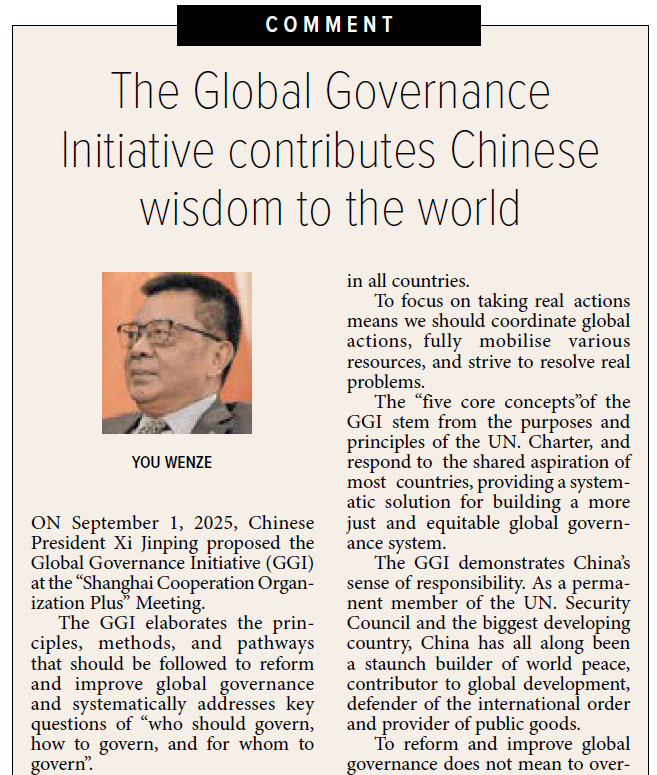
On September 1,2025,Chinese President Xi Jinping proposed the Global Governance Initiative (GGI) at the "Shanghai Cooperation Organization Plus" Meeting.
The GGI elaborates the principles, methods, and pathways that should be followed to reform and improve global governance and systematically addresses key questions of “ who should govern, how to govern, and for whom to govern”.
This important initiative points the way forward and provides a practical path for the reform and development of the global governance system, injecting strong impetus into promoting the building of a more just and equitable global governance system and working together for a community with a shared future for humanity.
The GGI aligns with the trend of history. This year marks the 80th anniversary of the founding of the United Nations. Eighty years ago, as a major victorious power in World War II, China joined hands with other countries around the world to establish the U.N., commencing a brand new practice in global governance.
Eighty years later, the world has entered a new period of turbulence and transformation. The current international landscape is undergoing changes and turbulence. Acts of hegemony and bullying have inflicted severe harm. The U.N. and multilateralism are being challenged. The deficit in global governance continues to grow.
Enhancing and improving global governance has become a common aspiration and urgent need of the international community, and countries around the world are looking forward to hearing more from China.
Focusing on a subject of our times, namely what kind of global governance system to build and how to reform and improve global governance, and regarding it as the fundamental guideline to uphold the purposes and principles of the U.N. Charter and practice the vision of global governance featuring extensive consultation and joint contribution for shared benefit, the GGI comes at the right time. It is in line with the needs of the times and the will of the people.
The GGI offers Chinese wisdom and Chinese solution. The five core concepts of the GGI are as follows: adhering to sovereign equality,abiding by international rule of law,practicing multilateralism, advocating the people-centered approach,focusing on taking real actions.
To adhere to sovereign equality means that all countries, regardless of size, strength and wealth, should be equal participants, decision-makers and beneficiaries in global governance.
To abide by international rule of law means that international law and rules should be applied equally and uniformly. There should be no double standards, and the house rules of a few countries must not be imposed upon others.
To practicing multilateralism means we should adhere to the principles of extensive consultation and joint contribution for shared benefit, strengthen solidarity and coordination, and oppose unilateralism. We should firmly safeguard the status and authority of the U.N.
To advocate the people-centered approach means we should reform and improve the global governance system to promote common development, so as to enhance the sense of gain, sense of security and sense of happiness of people in all countries.
To focus on taking real actions means we should coordinate global actions, fully mobilize various resources, and strive to resolve real problems.
The “five core concepts”of the GGI stem from the purposes and principles of the U.N. Charter, and respond to the shared aspiration of most countries, providing a systematic solution for building a more just and equitable global governance system.
The GGI demonstrates China's sense of responsibility. As a permanent member of the U.N. Security Council and the biggest developing country, China has all along been a staunch builder of world peace, contributor to global development, defender of the international order and provider of public goods.
To reform and improve global governance does not mean to overturn the existing international order or to create another framework outside the current international system. Rather, the goal is to make the existing international system and international institutions more just and equitable, better at taking actions, working effectively, adapting to changes,and responsive to the needs of all countries.
The GGI is another important public good that China has provided to the international community, following the Global Development Initiative, the Global Security Initiative and the Global Civilization Initiative.
The four global initiatives, addressing development, security, civilization, and governance,echo and complement each other, fully demonstrating China's strategic vision and sense of responsibility in leading the international community to jointly address the governance deficit and work together to build a community with a shared future for humanity at this critical historical turning point.
China and South Africa, both being Global South countries, are highly aligned in their commitment to multilateralism and promotion of common development, and serve as key forces in reforming and improving global governance. To enhance the representation of the Global South and rectify the unfair and unreasonable arrangements in the current global governance system, China is ready to work with South Africa and other Global South countries to make active efforts to improve global governance through concrete actions.
No matter how the international landscape changes, China will remain firm in safeguarding the international system with the U.N. at its core and the international order underpinned by international law, stand firmly on the right side of history, on the side of human progress, and on the side of multilateralism.
We are willing to join hands and make progress together with all countries in the world, to deliver more benefits to the entire humanity through the reform of the global governance system and the building of a community with a shared future for humanity.